
Induction charger
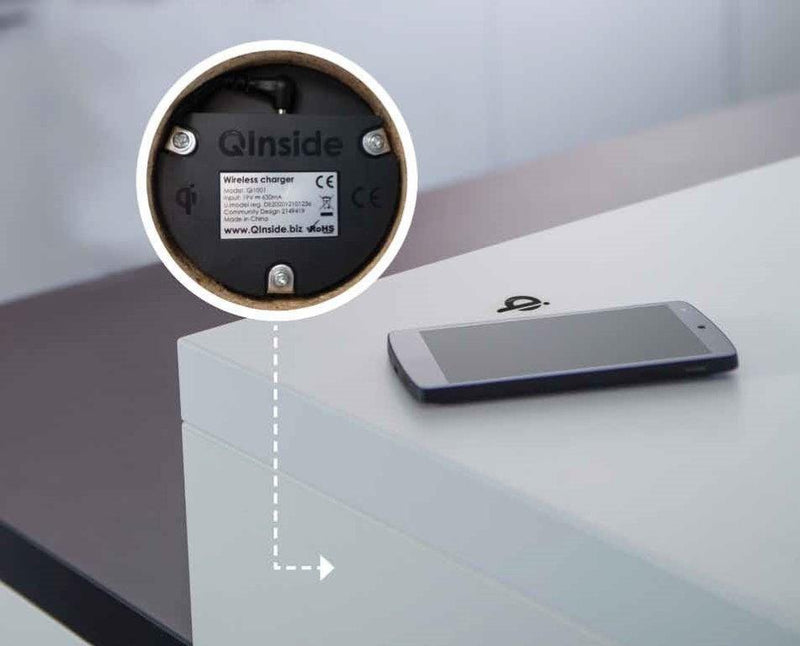
Le chargeur à induction Qi1001, standard universel Qi, s'intègre invisiblement dans votre mobilier et recharge fiablement iPhone, Samsung, LG, Google Nexus et bien d'autres, à la même vitesse qu'un câble classique. Pour les smartphones plus anciens non compatibles (iPhone 5-6-7, Android ancien), le récepteur Qi2001 les rend compatibles, disponible en sortie Lightning ou micro-USB.
5 products
Sort by:
5 products


Recessed induction charger + free micro USB receiver for Android.
-
Features
Installation: Recessed
Charging: Induction
Standard: Qi
Certifications: EN55022:2010+AC:2011, EN61000-3-2, EN61000-3-3, EN55024, EN61000-4-2, EN61000-4-3, EN61000-4-4, EN61000-4-5, EN61000-4-6,EN61000-4-8, EN61000-4-11, EMC 2014/30/EU
Power supply voltage: 5 V, 9 V (Transformer supplied)
Power: 15 W
Dimensions: Diameter: 8 cm x Height: 1.55 cm
Power cable length: 100 cm
The Qi1001 wireless charging station is the most versatile in the world of induction charging. It can be integrated into all materials except metallic or electro-conductive surfaces.
The station can be integrated into new furniture by the manufacturer and will be delivered ready to use to charge your devices. But it can also be installed in existing furniture (bar, table, desk, bedside table, ...).
The Qi1001 induction charger comes with a 5V - 9V power transformer, a 1.00 meter cable, and a cover. It can be installed invisibly by routing out a recess and leaving 3 mm of material between the charger and the furniture surface, or you can drill a hole in the furniture with an 8 cm diameter hole saw to integrate the charger and cover it with the supplied cover.
Once the induction charger is installed, simply place a Qi-compatible device on top of the source to charge it.
If your device is not equipped with induction charging technology, you can still charge it using the Qi2001 for Android, offered in this pack. -
Assembly video
-
Frequently asked questions
What is Qi wireless charging?
Qi is the new universal standard for wireless charging of battery-powered devices such as mobile phones, iPods, MP3 players, cameras...
Wireless power transmission is done by electromagnetic induction. With inductive power transmission, the energy required for electronic devices is not transmitted by cable but wirelessly via electromagnetic fields. The principle is very simple: the Qi emitter (charging station) transfers the required energy to the Qi receiver (the mobile phone).
Why wireless charging?
The biggest advantage of Qi wireless charging technology is that mobile phones and chargers from different manufacturers are compatible. The only requirement is that both devices, the transmitter and the receiver, comply with Qi specifications.
In this way, any Qi-compatible device can charge on a Qi-compatible charging station, regardless of the manufacturer or brand of the devices.
Many mobile phones, including those from market leaders such as iPhone 8, iPhone X, Nokia, Samsung, Sony, LG, Motorola, and HTC, are already compatible with the Qi standard and can therefore be charged on all Qi charging stations. More and more manufacturers are integrating Qi into their electronic devices, allowing them to charge different electronic devices with a single charging station without having various charging stations.
How does Qi wireless charging work?
Induction charging, wireless charging in the proper sense of the term, is not a completely new product. Electric toothbrushes have been working for years with the principle of induction charging.
Qi wireless charging uses resonant inductive coupling between the transmitter (charging station) and the receiver (mobile phone).
The transmitter produces a regular verification signal, which uses electromagnetic frequency to recognize if a device to be charged is on the Qi wireless charging station. The transmitter modulates the charging and verifies compatibility with the Qi standard.
Once Qi compatibility and the required energy are calculated, induction charging begins. During charging, the transmitter and receiver remain in contact and enter standby mode once the battery is fully charged.
Another advantage of the Qi charger is that it only turns on and transfers energy if a compatible device that needs to be charged is placed on it.
Thanks to this technology and very good insulation of the transmitting and receiving coils, electromagnetic radiation is fundamentally reduced.
Is wireless charging useful?
An infinite number of smartphones are available worldwide, and battery life has become shorter. Each brand, and even each device, has its own charger. Every time you buy a new device, you need a new compatible charger. You quickly end up with an unimaginable number of different chargers.
Wouldn't it be easier to have a single charger for all your phones, iPods, MP3 players, cameras, and no longer need those annoying cables?
Too good to be true?
Not with Qinside wireless induction charging stations!
Imagine a Qi wireless charging station for all your Qi-compatible phones. Forget all the different chargers and tangled cables and share a single charger at home, in the office, or on the go.
Imagine lounges, waiting rooms, airports, train stations, bars, and restaurants with Qi charging stations integrated into the furniture.
You can charge your devices whenever you want, regardless of the model, brand, or manufacturer of your device.
The only requirement is to have a Qi-compatible device or use the Qi2001 receiver for iPhone 4, iPhone 4s, and all phones with micro-USB connection, or use our Qi charging case for iPhone 5, iPhone 6, and iPhone 6+.
Fast and simple: charge your devices with wireless power transfer up to 10 watts.
Empty batteries in mobile phones, iPods, MP3 players, and cameras will be a thing of the past!
Qi, the international standard for induction charging?
Do you remember the first time you heard about Wi-FiTM or Bluetooth®?
Just as Wi-FiTM has become the international standard for wireless internet connections and Bluetooth® for hands-free, Qi will become the international standard for induction charging. The Qi standard is the future of wireless charging for battery-powered devices for everyone.
What is the extent of electromagnetic radiation from Qi wireless charging systems?
Minimal. The Qi principle has been used for years, without any known physical effect on human health, in electronic toothbrushes. Given the low range of Qi wireless charging technology, electromagnetic radiation is very limited. Electromagnetic radiation has a low emission around the Qi charging station and only when a device is placed on the charging station.
Thanks to the additional insulation of the transmitting and receiving coils of the Qi standard, the emitted electromagnetic radiation is reduced.
Why is there an international standard for wireless charging?
Founded on December 17, 2008, the Wireless Power Consortium (WPC) adopted the Qi standard for induction charging in the same year. The introduction of the global Qi standard enables universal induction charging for all Qi-compatible electronic devices.
This means that any Qi-compatible device can charge on any Qi-compatible charging station. The Wireless Power Consortium currently has 250 members, including market leaders such as Samsung, Nokia, LG, Panasonic, HTC, Sony, and Motorola, the largest union for wireless induction charging.
According to WPC Chairman Menno Treffers, due to the increase in Qi products, it is essential to ensure that all wireless chargers work correctly with all mobile devices. The database created and regularly updated by Testronic, of Qi-compliant products, makes it simple to verify if a new product works with all previously certified products.
According to Johan Craeybecks, Director of Technology at Testronic Labs, "We believe that the introduction of the Qi standard is one of the most important technical developments for users of mobile devices such as laptops, tablets, or other devices, which nowadays are part of daily business or private life."
Can several phones be charged on a Qi1001 charger?
No, the charging capacity of a Qi charger is adapted to a single device.
Additional information
- Brand: EUBIQ
- Weight: 260 g
- Dimensions (L × W × H): 16 × 11 × 5 cm


Induction charger + induction receiver with free iPhone connector.
-
Features
Installation : Flush-mounted
Charging : Induction
Standard: Qi
Certifications : EN55022:2010+AC:2011, EN61000-3-2, EN61000-3-3, EN55024, EN61000-4-2, EN61000-4-3, EN61000-4-4, EN61000-4-5, EN61000-4-6,EN61000-4-8, EN61000-4-11, EMC 2014/30/EU
Input voltage : 5 V, 9 V (Transformer supplied)
Power : 15 W
Dimensions : Diameter: 8 cm x Height: 1.55 cm
Power cable length : 100 cm
The Qi1001 wireless charging station is the most versatile in the world of induction charging. It can be integrated into all materials except metal or electro-conductive surfaces.
The station can be integrated into new furniture by the manufacturer and will be delivered ready to use to charge your devices. However, it can also be installed in existing furniture (bar, table, desk, bedside table, etc.).
The Qi1001 induction charger is supplied with a 5V - 9V power transformer, a 1.00 meter cable and a cover. It can be installed invisibly by routing out a recess and leaving 3 mm of material between the charger and the furniture surface, or you can drill an 8 cm diameter hole in the furniture with a hole saw to integrate the charger and cover it with the supplied cover.
Once the induction charger is installed, simply place a Qi-compatible device on top of the source to recharge it.
If your device is not equipped with induction charging technology, you can still charge it using the Qi2001 for iPhone, included in this pack. -
Assembly video
-
Frequently Asked Questions
What is Qi wireless charging?
Qi is the new universal standard for wireless charging of battery-powered devices such as mobile phones, iPods, MP3 players, cameras, etc.
Wireless power transmission is done by electromagnetic induction. With induction power transmission, the power required for electronic devices is not transmitted by cable but wirelessly via electromagnetic fields. The principle is very simple: the Qi transmitter (charging station) transfers the required power to the Qi receiver (the mobile phone).
Why wireless charging?
The biggest advantage of Qi wireless charging technology is that mobile phones and chargers from different manufacturers are compatible. The only requirement is that both devices, transmitter and receiver, comply with Qi specifications.
In this way, any Qi-compatible device can charge on a Qi-compatible charging station, regardless of the manufacturer or brand of the devices.
Many mobile phones, including those from market-leading brands such as iPhone 8, iPhone X, Nokia, Samsung, Sony, LG, Motorola and HTC, are already compatible with the Qi standard and can therefore charge on all Qi charging stations. More and more manufacturers are integrating Qi into their electronic devices, allowing them to charge different electronic devices with a single charging station without having various charging stations.
How does Qi wireless charging work?
Induction charging, wireless charging in the true sense of the word, is not a completely new product. Electric toothbrushes have been operating on the principle of induction charging for years.
Qi wireless charging uses resonant inductive coupling between the transmitter (charging station) and the receiver (mobile phone).
The transmitter produces a regular verification signal, which uses the electromagnetic frequency to recognise whether a device to be charged is on the Qi wireless charging station. The transmitter modulates the charging and checks for Qi standard compatibility.
Once Qi compatibility and the required energy are calculated, induction charging begins. During charging, the transmitter and receiver remain in contact and go into standby mode once the battery is fully charged.
Another advantage of the Qi charger is that it only turns on and transfers energy if a compatible device that needs to be charged is placed on it.
Thanks to this technology and very good insulation of the transmitting and receiving coils, electromagnetic radiation is fundamentally reduced.
Is wireless charging useful?
An infinite number of smartphones are available worldwide, and battery life has become shorter. Each brand, and even each device, has its own charger. Every time you buy a new device, you need a new compatible charger. You quickly end up with an unimaginable number of different chargers.
Wouldn't it be easier to have a single charger for all your phones, iPods, MP3 players, cameras, and no longer need those annoying cables?
Too good to be true?
Not with Qinside wireless induction charging stations!
Imagine a Qi wireless charging station for all your Qi-compatible phones. Forget all the different chargers and tangled cables and share a single charger at home, in the office or on the go.
Imagine lounges, waiting rooms, airports, train stations, bars and restaurants with Qi charging stations integrated into the furniture.
You can charge your devices whenever you want, regardless of the model, brand or manufacturer of your device.
The only requirement is to have a Qi-compatible device or use the Qi2001 receiver for iPhone 4, iPhone 4s and all phones with micro-USB connection, or use our Qi charging case for iPhone 5, iPhone 6 and iPhone 6+.
Fast and simple: charge your devices with wireless power transfer of up to 10 watts.
Empty batteries in mobile phones, iPods, MP3 players and cameras will be a thing of the past!
Qi, the international standard for induction charging?
Do you remember the first time you heard about Wi-FiTM or Bluetooth®?
Just as Wi-FiTM has become the international standard for wireless internet connections and Bluetooth® for hands-free devices, Qi will become the international standard for induction charging. The Qi standard is the future of wireless battery charging for everyone.
What is the extent of electromagnetic radiation from Qi wireless charging systems?
Minimal. The Qi principle has been used for years in electronic toothbrushes without any known physical effect on human health. Given the limited range of Qi wireless charging technology, electromagnetic radiation is very low. Electromagnetic radiation has a low emission around the Qi charging station and only when a device is placed on the charging station.
Thanks to the additional insulation of the transmitting and receiving coils of the Qi standard, the emitted electromagnetic radiation is reduced.
Why is there an international standard for wireless charging?
Founded on December 17, 2008, the Wireless Power Consortium (WPC) adopted the Qi standard for induction charging the same year. The introduction of the global Qi standard enables universal induction charging of all Qi-compatible electronic devices.
This means that any Qi-compatible device can charge on any Qi-compatible charging station. The Wireless Power Consortium currently has 250 members, including market leaders such as Samsung, Nokia, LG, Panasonic, HTC, Sony and Motorola, making it the largest union for wireless induction charging.
According to WPC chairman Menno Treffers, due to the increase in Qi products, it is essential to ensure that all wireless chargers work correctly with all mobile devices. The database created and regularly updated by Testronic, of Qi-compliant products, makes it easy to check if a new product works with all previously certified products.
According to Johan Craeybecks, CTO at Testronic Labs, "We believe that the introduction of the Qi standard is one of the most important technical developments for users of mobile devices such as laptops, tablets or other devices, which nowadays are part of daily business or private life."
Can several phones be charged on a Qi1001 charger?
No, the charging capacity of a Qi charger is adapted for a single device.
Additional information
- Brand : EUBIQ
- Weight : 260 g
- Dimensions (L × W × H) : 16 × 11 × 5 cm


Induction receiver with iPhone connector
Charging: Induction- Connector: iPhone (Lightning)
- Standard: Qi
Dimensions:
- Length: 55.6 mm
- Width: 54.4 mm
- Height: 5.5 mm
The Qi2001 induction receiver is the answer to universal charging compatibility. Recent iPhone 8 and X models are Qi compatible. For older versions, the receiver will be necessary to charge them on Qi wireless charging stations.
Connect the receiver to your device and place it on top of the induction charger, charging begins...
Additional information
- Brand: Qinside
- Weight: 20 g
- Dimensions (L × W × H): 6 × 6 × 1 cm


Induction receiver with micro USB connector
Charging: Induction- Connector: micro USB (Android)
- Standard: Qi
Dimensions:
- Length: 55.6 mm
- Width: 54.4 mm
- Height: 5.5 mm
The Qi2001 induction receiver is the answer to universal charging compatibility. Recent phone models are Qi compatible; for versions that do not yet have integrated Qi technology, the receiver will be necessary to charge them on Qi wireless charging stations.
Connect the receiver to your device and place it on top of the induction charger, charging begins...
Additional Information
- Brand: Qinside
- Weight: 20 g
- Dimensions (L × W × H): 6 × 6 × 1 cm


Built-in inductive charger for smartphones, Qi technology.
-
Features
Installation : Flush-mounted
Charging : Induction
Standard: Qi
Certifications : EN55022:2010+AC:2011, EN61000-3-2, EN61000-3-3, EN55024, EN61000-4-2, EN61000-4-3, EN61000-4-4, EN61000-4-5, EN61000-4-6,EN61000-4-8, EN61000-4-11, EMC 2014/30/EU
Power Supply Voltage : 5 V, 9 V (Transformer supplied)
Power : 15 W
Dimensions : Diameter : 8 cm x Height : 1.55 cm
Power cable length : 100 cm
The Qi1001 wireless charging station is the most versatile in the world of inductive charging. It integrates into all materials except metal or electro-conductive surfaces.
The station can be integrated into new furniture by the manufacturer and will be delivered ready to use for charging your devices. But it can also be installed in existing furniture (bar, table, desk, bedside table, etc.).
The Qi1001 inductive charger is supplied with a 5V - 9V power transformer, a 1.00 meter cable and a cover. It can be installed either invisibly, in which case a recess will need to be made, leaving 3 mm of material between the charger and the surface of the furniture, or you can drill a hole in the furniture with an 8 cm diameter hole saw to integrate the charger and cover it with the supplied cover.
Once the inductive charger is installed, simply place a Qi-compatible device on top of the source to recharge it.
If your device is not equipped with induction charging technology, you can still charge it using one of the Qi2001 receivers with a micro-USB connector or an iPhone connector. -
Assembly video
-
Frequently Asked Questions
What is Qi wireless charging?
Qi is the new universal standard for wireless charging of battery-powered devices such as mobile phones, iPods, MP3 players, cameras...
Wireless power transmission is done by electromagnetic induction. With inductive power transmission, the energy required for electronic devices is not transmitted by cable but wirelessly via electromagnetic fields. The principle is very simple: the Qi emitter (charging station) transfers the required energy to the Qi receiver (the mobile phone).
Why wireless charging?
The biggest advantage of Qi wireless charging technology is that mobile phones and chargers from different manufacturers are compatible. The only requirement is that both devices, transmitter and receiver, comply with Qi specifications.
In this way, any Qi-compatible device can charge on a Qi-compatible charging station, regardless of the manufacturer or brand of the devices.
Many mobile phones, including those from market-leading brands such as iPhone 8, iPhone X, Nokia, Samsung, Sony, LG, Motorola and HTC, are already compatible with the Qi standard and can therefore charge on all Qi charging stations. More and more manufacturers are integrating Qi into their electronic devices, allowing them to charge different electronic devices with a single charging station without having various charging stations.
How does Qi wireless charging work?
Inductive charging, wireless charging in the true sense of the word, is not a completely new product. Electric toothbrushes have been working for years with the principle of inductive charging.
Qi wireless charging uses resonant inductive coupling between the emitter (charging station) and the receiver (mobile phone).
The emitter produces a regular verification signal, which recognizes, thanks to the electromagnetic frequency, whether a device to be charged is on the Qi wireless charging station. The emitter modulates the charging and verifies compatibility with the Qi standard.
Once Qi compatibility and the required energy have been calculated, inductive charging begins. During charging, the emitter and receiver remain in contact and go into standby mode once the battery is fully charged.
Another advantage of the Qi charger is that it only turns on and transfers energy if a compatible device that needs to be recharged is placed on it.
Thanks to this technology and very good insulation of the transmitting and receiving coil, electromagnetic radiation is fundamentally reduced.
Is wireless charging useful?
An infinite number of smartphones are available worldwide, and battery life has become shorter. Each brand, and even each device, has its own charger. Every time you buy a new device, you need a new compatible charger. You quickly end up with an unimaginable number of different chargers.
Wouldn't it be easier to have a single charger for all your phones, iPods, MP3 players, cameras, and no longer need those annoying cables?
Too good to be true?
Not with Qinside wireless inductive charging stations!
Imagine a Qi wireless charging station for all your Qi-compatible phones. Forget all the different chargers and tangled cables and share a single charger at home, in the office or on the go.
Imagine lounges, waiting rooms, airports, train stations, bars and restaurants with Qi charging stations integrated into the furniture.
You can charge your devices whenever you want, regardless of the model, brand or manufacturer of your device.
The only requirement is to have a Qi-compatible device or use the Qi2001 receiver for iPhone 4, iPhone 4s and all phones with micro-USB connection or use our Qi charging case for iPhone 5, iPhone 6 and iPhone 6+.
Fast and simple: charge your devices with wireless power transfer up to 10 watts.
Empty batteries in mobile phones, iPods, MP3 players and cameras will be a thing of the past!
Qi, the international standard for inductive charging?
Do you remember the first time you heard about Wi-Fi™ or Bluetooth®?
Just as Wi-Fi™ has become the international standard for wireless internet connections and Bluetooth® for hands-free devices, Qi will become the international standard for inductive charging. The Qi standard is the future of wireless charging for battery-powered devices for everyone.
What is the extent of electromagnetic radiation from Qi wireless charging systems?
Minimal. The Qi principle has been used for years, with no known physical effects on human health, in electronic toothbrushes. Given the limited range of Qi wireless charging technology, electromagnetic radiation is very limited. Electromagnetic radiation has a low radiation around the Qi charging station and only when a device is placed on the charging station.
Thanks to the additional insulation of the transmitting and receiving coil of the Qi standard, the emitted electromagnetic radiation is reduced.
Why is there an international standard for wireless charging?
Founded on December 17, 2008, the Wireless Power Consortium (WPC) adopted the Qi standard for inductive charging in the same year. The introduction of the global Qi standard enables universal inductive charging of all Qi-compatible electronic devices.
This means that any Qi-compatible device can be charged on any Qi-compatible charging station. The Wireless Power Consortium currently has 250 members, including market leaders such as Samsung, Nokia, LG, Panasonic, HTC, Sony and Motorola, the largest union for wireless inductive charging.
According to WPC Chairman Menno Treffers, due to the increase in Qi products, it is essential to ensure that all wireless chargers work correctly with all mobile devices. The database created and regularly updated by Testronic, of Qi-compliant products, makes it simple to verify if a new product works with all previously certified products.
According to Johan Craeybecks, Testronic Labs' technology director, "We believe that the introduction of the Qi standard is one of the most important technical developments for users of mobile devices such as laptops, tablets or other devices, which nowadays are part of daily business or private life."
Can several phones be charged on a Qi1001 charger?
No, the charging capacity of a Qi charger is adapted to a single device.
Additional Information
- Brand : Qinside
- Weight : 223 g
- Dimensions (L × W × H) : 16 × 11 × 5 cm
Quel chargeur à induction est fait pour vous ?
Répondez à 3 questions simples pour identifier la solution de charge sans fil la mieux adaptée à votre smartphone et à votre usage. En moins d'une minute, vous saurez exactement ce qu'il vous faut.
Question 1 sur 3
Quel smartphone souhaitez-vous recharger sans fil ?
La compatibilité Qi native dépend du modèle. Cette question est essentielle pour déterminer si un accessoire supplémentaire est nécessaire.
Question 2 sur 3
Avez-vous déjà un chargeur à induction Qi ?
Cela nous permet de savoir si vous avez besoin du chargeur seul, d'un récepteur seul, ou d'un kit complet.
Question 3 sur 3
Quelle est votre priorité principale ?
Cela nous aide à affiner la recommandation entre un kit tout-en-un pratique ou des éléments séparés.
Votre recommandation personnalisée
Qi inductive charging is the leading standard used worldwide. It is compatible with many smartphones: iPhone, Samsung, LG, Google Nexus, and many others.
This charger will be invisible in your environment and can be easily integrated into furniture. You can modernize old furniture by integrating a QI1001 induction charger.
Qi wireless charging stations are easily integrated into furniture.
Products charge reliably and at the same speed as charging with a conventional cable.
With the universal Qi standard for wireless charging, countless different chargers are a thing of the past.
Incompatible devices such as Apple iPhones 5-6-7 or older Android smartphones can be made compatible thanks to the Qi2001 receiver, which is available in two versions: A version with a Lightning output (for iPhones) or with a micro-USB output for most Android devices.
Collections en vedette


The French specialist in designer electrical tracks since 2008. Exclusive Eubiq importer in Europe — Dilectro Ltd.
The French specialist in designer electrical tracks since 2008. Exclusive Eubiq importer in Europe — Dilectro Ltd.